


I recently took a multimodal road trip from Miami to Asheville, NC. I rode Brightline from Miami to Orlando to skip the South Florida traffic, then rented a car. I did my planning internship for the City of Asheville, so I’m familiar with the area and was excited to see how it evolved over the past decade. What surprised me most is how little the city changed.
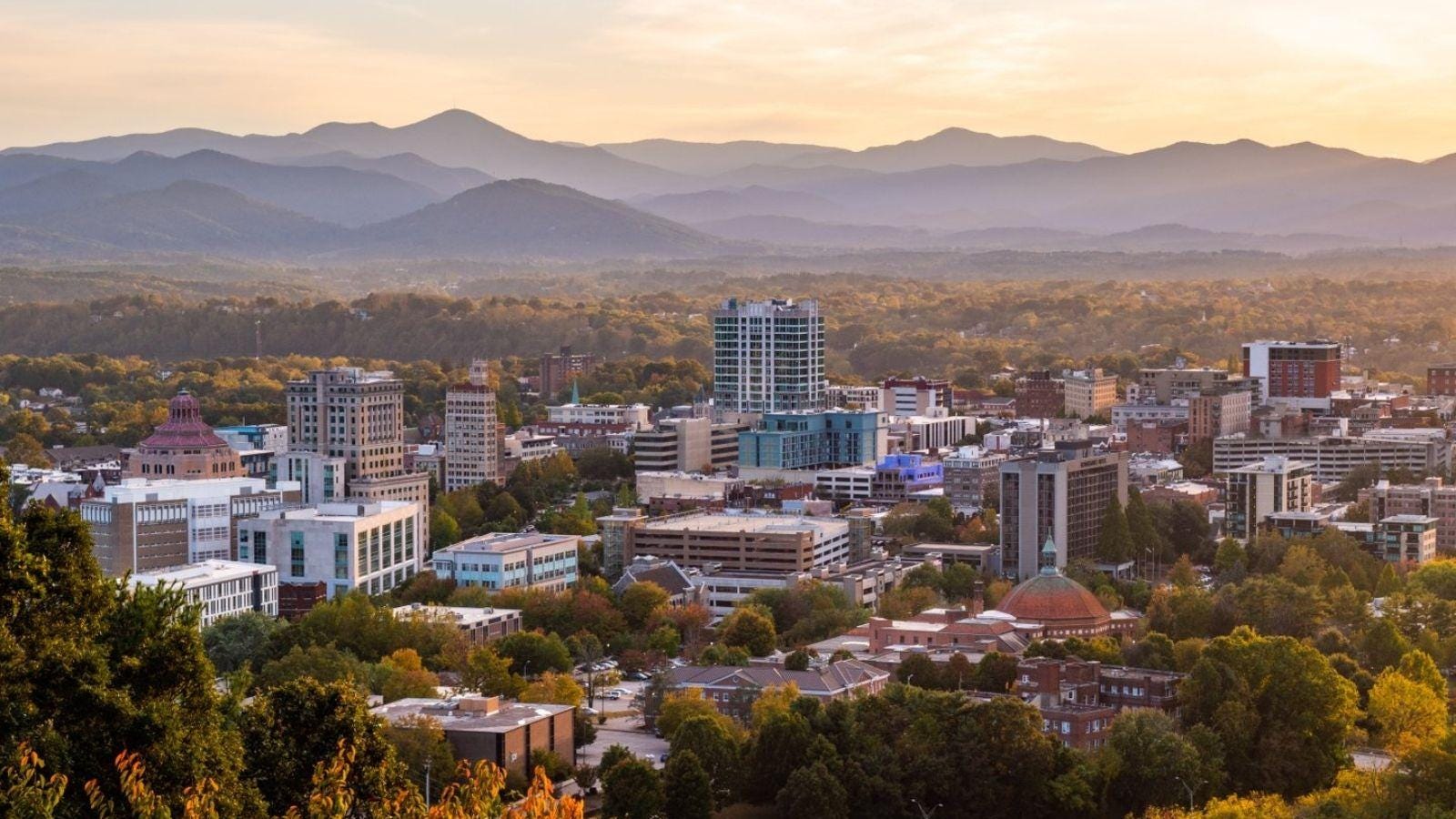
Rolling into West Asheville, I saw a few new small businesses, and also a few new vacancies. Several new tasteful rowhomes and commercial buildings lined Haywood Road, and new apartment buildings have gone up near the French Broad River. Downtown was exactly the way I remembered it, filled with arts and crafts stores, restaurants and bars. New hotel conversions like the Flatiron Hotel, built in 1926, are great for tourists, but it was surprising that there wasn’t more redevelopment for residents of the city. A new urban grocery store or more infill multifamily projects would have been nice.
Most of the downtown streets were empty around 7pm on a Friday, and foot traffic was slim even during weekday afternoons. Was I expecting Midtown Atlanta? No, but I was expecting more activity and infill residential growth, especially downtown.
Since I had an extra day to explore, I made a side quest to Greenville, SC with a buddy. I spent a lot of time there while I attended Clemson, and considered Greenville an equal Asheville. We entered downtown through the Swamp Rabbit Trail that was packed with people. As we got closer to the center of the city, we saw new 25 story apartment buildings that looked like they belonged in Miami. New office buildings adorned the perimeter of downtown, and Main St. was closed to vehicular traffic for a weekend farmer’s market that was filled with people.
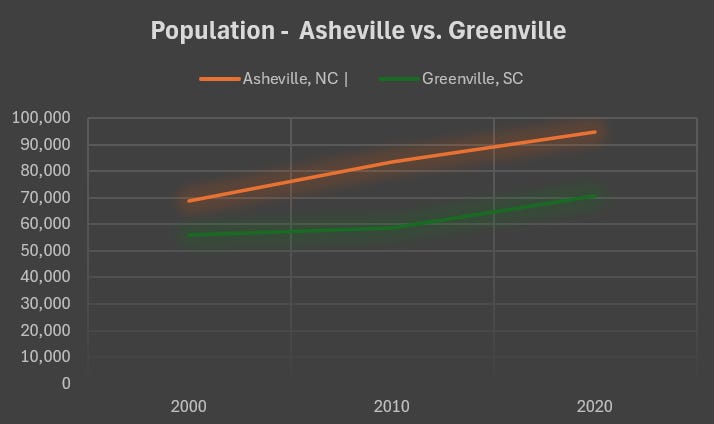
Greenville seemed a lot more vibrant and alive compared to Asheville. Did they have a population boom I wasn’t aware of? Not according to the U.S. Census. In fact, Asheville still has 20,000 more people. But it seems Greenville has a different economic development strategy: Densify the core and commercial nodes, promote walkability, and diversify the economy.
Let’s compare the two cities in more depth.
Economic Diversity
Economic diversity is a cornerstone of urban resilience, ensuring cities can withstand sector-specific downturns. Asheville’s economy is heavily anchored in tourism, which generates approximately $3 billion annually and supports 14 percent of Buncombe County’s jobs, primarily in hospitality and creative industries. The Biltmore Estate, craft breweries, and the River Arts District draw millions of visitors, but this focus creates vulnerabilities. A 2021 economic impact report noted that tourism-related jobs in Asheville, such as those in food service and lodging, pay an average of $27,000 to $32,000 annually, well below the county’s living wage of $41,800. The city’s reliance on visitor spending was starkly exposed after Hurricane Helene in 2024, which halted tourism and left 20,000 local workers without income.
Greenville, by contrast, boasts a more diversified economic base. While tourism contributes significantly, with the Greenville Drive minor league baseball team alone generating $300 million over a decade, the city’s economy is bolstered by manufacturing, healthcare, and professional services. Major employers like Michelin, BMW, and GE Energy have established operations in Greenville, creating high-wage jobs and fostering a robust middle class. The United Way of Greenville County reports that the city’s unemployment rate is consistently below the national average, and its industrial diversity supports economic stability. However, Greenville faces challenges in economic mobility, particularly in underserved areas like the White Horse Corridor, where 32 percent of households live in poverty. Despite this, Greenville’s broader sectoral mix provides a buffer against economic shocks.
Walkability
Walkability is a critical measure of urban livability, promoting health, reducing car dependency, and enhancing community cohesion. Asheville’s downtown is celebrated for its pedestrian-friendly core, with a Walk Score of 89, the second highest in North Carolina. Neighborhoods like Downtown Asheville and West Asheville feature eclectic shops, restaurants, and galleries within a compact, navigable area. The city’s Art Deco architecture and festivals enhance its appeal for pedestrians. However, walkability diminishes outside the urban core, where sprawling suburbs and limited transit options necessitate car use. The Asheville City Council’s goal to reduce carbon emissions by 80 percent by 2030 includes investments in pedestrian infrastructure, but progress is slow, and the city’s hilly terrain poses challenges for universal accessibility.
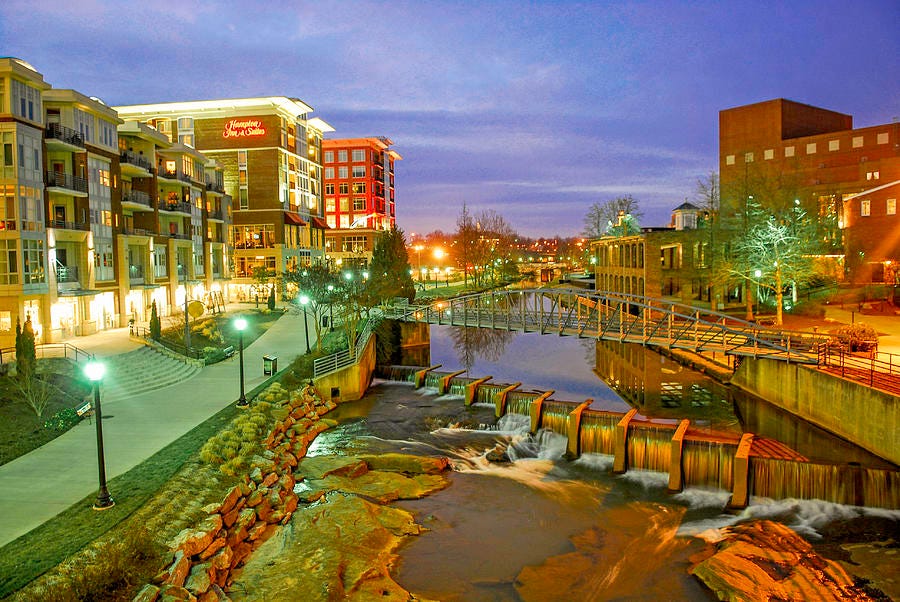
Greenville excels in walkability, with its downtown ranked among America’s top ten by Forbes. The centerpiece is Falls Park on the Reedy, connected by a pedestrian suspension bridge that anchors a vibrant shopping and entertainment district. Downtown Greenville’s Walk Score is comparable to Asheville’s, but its 28-mile Swamp Rabbit Trail, a paved multi-use path linking major attractions, enhances pedestrian and cyclist connectivity. Morgan Square and NOMA Square host events like Music on Main, fostering a lively streetscape. Unlike Asheville, Greenville’s walkable areas extend beyond the downtown core as well. The city’s flat topography and strategic investments in greenways align with its emphasis on designing for active transportation. And one of the most overlooked and underrated amenities of a walkable neighborhood (a grocery store) was recently built a few blocks off of Main St.
Tourism Dependency
Tourism can drive economic growth but risks creating a monoculture economy if not balanced with other sectors. Asheville’s tourism industry is a juggernaut, contributing $2.96 billion to Buncombe County in 2023 and ranking third in North Carolina for visitor spending. The city’s marketing, funded by a $40 million occupancy tax, has transformed it into a national destination. However, this success comes at a cost. High rents, driven by short-term rentals, and low wages in tourism jobs exacerbate affordability issues. A 2023 Asheville Watchdog analysis found that the city’s focus on promotion over infrastructure investment has strained local resources, echoing Planetizen’s warnings about tourism’s social and economic impacts. Post-Hurricane Helene, the closure of attractions like the Biltmore Estate underscored the fragility of an economy tethered to visitor flows.
Greenville, while a growing tourism destination, maintains a more balanced approach. The city attracted 7.89 million visitors in 2024, generating significant revenue through events at Fluor Field and cultural attractions like the Greenville County Museum of Art. However, tourism is not the sole economic driver. Greenville’s 10-Year Destination Strategic Plan (2023-2033) emphasizes sustainable visitor experiences that complement, rather than dominate, the local economy. The city’s hospitality sector supports jobs, but its manufacturing and healthcare industries provide a stable foundation. Southern Living praised Greenville’s “big city perks with small town feel,” reflecting a diversified appeal that mitigates over-reliance on tourism. This aligns with APA’s advocacy for integrated economic strategies that prioritize long-term community well-being.
Highways
I’d be remiss if I didn’t mention highway access and its impact on economic development. Greenville is way more accessible to commuters and employers given its location on I-85, a major highway connecting Atlanta and Charlotte. This is one of the few circumstances where a straight, fast highway is a good thing. A person can easily live 60 miles from Greenville and commute into the city in a reasonable amount of time. Doing the same in Asheville means traveling curvy, mountainous roads that are prone to rain and sometimes ice. Businesses consider these things when selecting new development sites.
Seeing both cities evolve over the past decade brought their different economic development strategies into focus. Asheville and Greenville have distinct urban identities, but Greenville emerges as more economically diverse, walkable, and less tourism dependent. Its multi-sector economy, anchored by manufacturing and healthcare, provides resilience against external shocks. Greenville’s superior walkability, supported by extensive greenways and a pedestrian-friendly downtown, fosters a connected and active community, embodying principles of human-oriented design. While Asheville’s tourism has fueled growth, its vulnerabilities highlight the risks of a singular focus. Greenville’s balanced approach offers a blueprint for sustainable urban development, creating a great example for long-term livability and economic diversity in the Southeast.
Have you visited Asheville or Greenville? I’m interested to hear your thoughts in the comments.
I loved the post! I recently visited Asheville without knowing anything about it (I'm from Mexico and tbh I never herad of it before), I spent a night over there in a downtown hotel. The city was beautiful, I loved the architecture, but it felt like it was missing a lot of people, only Broadway felt somewhat alive. I also noticed and agree about the importance of a good grocery store for a neighbourhood, I only saw French Broad food co-op, it was nice but on the outskirts of downtown. And prices for apartments in the downtown core were surprisingly expensive. Hopefully Asheville can turn itself around, is a beautiful city with a lot of potential
Greenville is a wonderful city. I have been there twice for NCAA tournament weekends. It is a great place to just wander around and find things to do. There are a lot of places to eat and drink and things to see. Looking forward to going again next March.